
What We See on a Typical Service Call
The calls about a garage door that won't open rarely sound the same twice. One homeowner says the remote does nothing at all, not even a light on the opener. Another says the motor hums and the chain moves, but the door itself sits still. A third says the door gets about six inches off the ground, stops, and reverses back down every time. All three of these end up being completely different repairs, which is why a technician doesn't guess, they work through a fixed sequence until they find the actual fault.
In this part of Florida, that sequence gets a few extra wrinkles. Humidity swells wood and composite panels so they bind in the track. Afternoon storms knock out power or cause surges that trip breakers and confuse opener logic boards. Salt air near the coastal stretches toward Horseshoe Beach and Steinhatchee speeds up rust on springs, hinges, and rollers. All of that gets factored in before a tool ever comes out of the truck.
The Diagnostic Order
1. Power to the Opener
First check is always the simplest: is the opener getting power at all? A tripped breaker, an unplugged cord knocked loose during a storm, or a dead battery backup after an outage will stop a door cold with zero drama. The fix here is just restoring power or replacing the backup battery, no parts needed beyond that.
2. Remote vs. Wall Button
If the wall-mounted button opens the door but the remote doesn't, the problem is isolated to the remote itself, usually a dead battery or a unit that's lost its programming after a power surge. If neither the remote nor the wall button does anything, the issue is upstream in the opener or the power supply, and the technician moves on rather than wasting time on the remote.
3. Safety Sensors (Photo Eyes)
These small sensors sit a few inches off the ground on each side of the track and have to see each other in a straight line for the door to close or, on some systems, to operate at all. Humidity causes condensation on the lenses, spiders build webs across the beam, and lawn equipment or storm debris can knock a bracket out of alignment. A dirty or misaligned sensor often shows up as a blinking light on the opener and a door that reverses or refuses to move. The fix is usually wiping the lenses, realigning the brackets, and confirming both LEDs show a steady light instead of blinking.
4. Broken or Weakened Springs
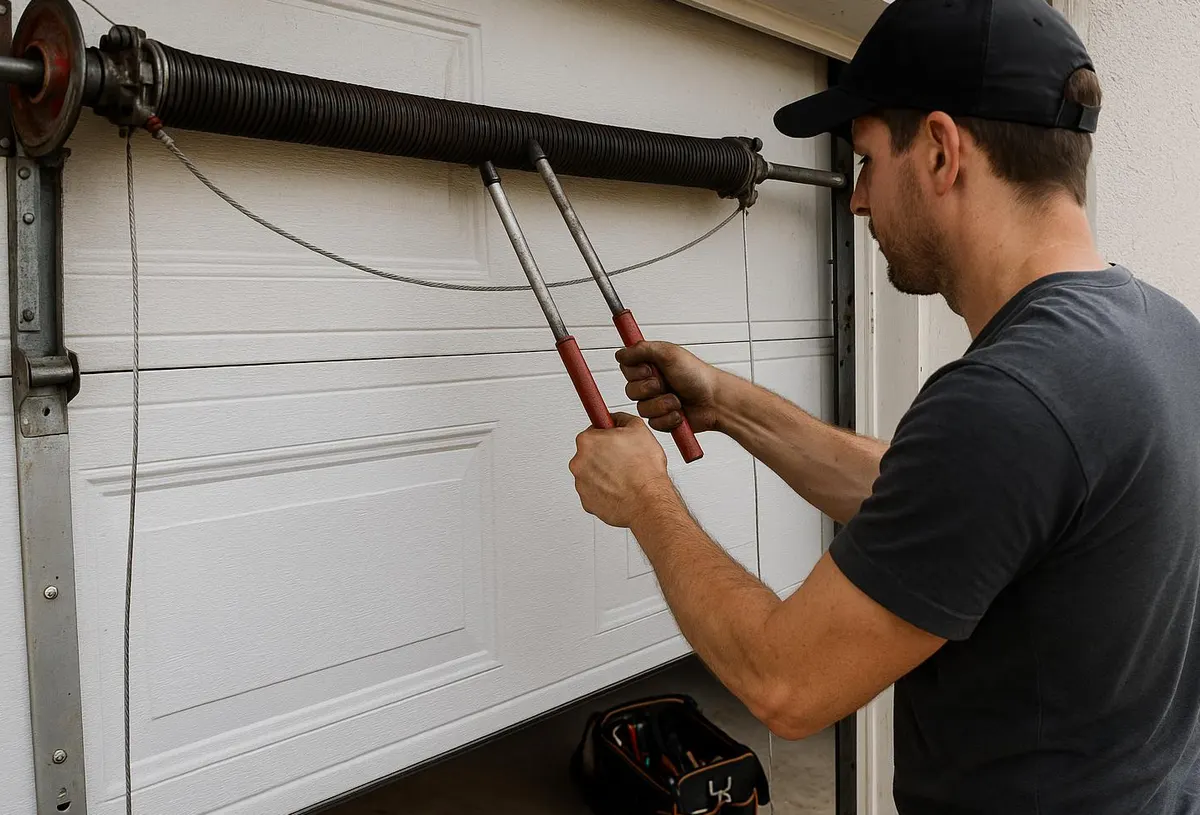
If the door won't move by opener or by hand, and it feels unusually heavy when lifted manually, a spring has likely broken or lost tension. Torsion springs wear out from cycle count, and in this climate rust from humidity and salt air accelerates fatigue on top of normal wear. A broken spring is also a safety issue, since the opener isn't built to lift the full weight of the door on its own long-term. The fix is spring replacement, matched to the door's weight and wound to the correct tension, not a quick patch.
5. Cables and Rollers
Next check is the cables running alongside the springs. A frayed or snapped cable lets one side of the door sag or hang crooked in the track, which binds the door and can trip the opener's resistance sensors so it stops partway. Worn or rusted rollers cause similar binding, especially on older tracks exposed to moisture. The fix is replacing the cable or roller and making sure the door is sitting level in both tracks before testing it again.
6. Opener Drive Mechanism
If power, sensors, springs, and cables all check out but the door still won't move, the problem is likely inside the opener itself, a stripped drive gear, a worn belt or chain, or a motor that's reached the end of its service life. A stripped gear often shows up as the motor running while the trolley doesn't move at all. The fix ranges from a gear or belt replacement to a full opener swap if the motor itself has failed.
7. Manual Disconnect or Lock
Last on the list because it's the least common, but worth ruling out: the emergency release cord may have been pulled accidentally, or a manual lock on the door itself may be engaged. Either one disconnects the door from the opener entirely. The fix is simply resetting the mechanism, but it's checked last because it's rarely the actual cause on a well-maintained door.
When to Call Precision Garage Door of Cross City
If your door is heavy to lift by hand, won't move at all, or reverses partway through opening, it's time to call rather than keep testing the remote. A technician can diagnose which of the steps above is the actual cause and handle it safely, which matters most with springs and cables since they're under heavy tension. We handle Garage Door Spring Repair and Garage Door Cable Repair regularly across Cross City and the surrounding Dixie County area, and a Garage Door Tune-Up & Maintenance visit can catch rust, worn rollers, and sensor misalignment before they turn into a door that won't open at all.
If your garage door in Cross City, Old Town, Chiefland, or anywhere nearby isn't opening the way it should, call Precision Garage Door of Cross City and we'll get it diagnosed and running right.